


Back to Top
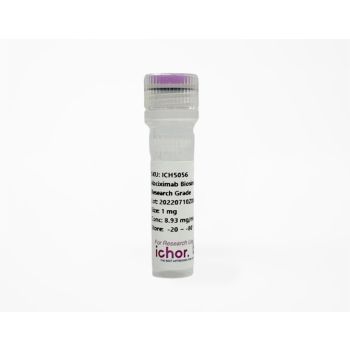
Daclizumab Biosimilar - Research Grade
$315.00 - $19,890.00
Frequently Bought Together


Loading...
Daclizumab Biosimilar - Research Grade
Endotoxin
≤ 1.0 EU/mg as determined by the LAL method
Purity
>95% by SDS-PAGE
Species Reactivity
Human
Target
IL2RA
Concentration
>1mg/ml
Isotype
Human IgG1
Antibodies Against The Same Target
Anti-Mouse CD25 (PC61) In Vivo Antibody - Low Endotoxin (ICH1054), Bulk Anti-Human CD25 (7G7B6) Antibody (ICH1163), Camidanlumab Biosimilar - Research Grade (ICH5090), Anti-Human CD25 (IB7) Antibody (ICH5189A), Inolimomab Biosimilar - Research Grade (ICH5605), Vopikitug Biosimilar - Research Grade (ICH5990)
Sequence
https://www.imgt.org/mAb-DB/
Buffer
ICH3002
Uniprot
P01589
Gene Id
3559
Rrid
RRID:AB_2921568
Shipping Conditions
Blue ice
Background
This is an unconjugated, non-therapeutic recombinant analog of daclizumab, a humanized IgG1 monoclonal antibody directed against IL2RA (CD25), the alpha chain of the high-affinity interleukin-2 receptor. It is manufactured for research use only and is not the clinical drug, not for human or veterinary use. The molecule reproduces the antigen-binding specificity of the originator, making it a convenient tool for laboratory studies of CD25 biology, IL-2 signaling, and regulatory T-cell dynamics. Typical applications include use as a well-characterized binding reference, a positive or isotype-matched control in assay development, a capture or detection reagent, and a benchmark in comparability and biosimilarity workflows. It is supplied at research grade with low endotoxin (<1 EU/mg, with an ultra-low <0.5 EU/mg option) and is available in bulk milligram-to-gram quantities to support in-vitro assays, ADCC/ADC development pipelines, and preclinical model work. As an anti-CD25 analog it is useful for probing IL-2 pathway modulation and immune-tolerance mechanisms in controlled experimental settings.
IL2RA (CD25, Tac antigen) encodes the alpha subunit of the interleukin-2 receptor. Alone it binds IL-2 with low affinity, but when it assembles with the beta (IL2RB/CD122) and common gamma (IL2RG/CD132) chains it forms the high-affinity trimeric receptor that drives downstream JAK/STAT5, PI3K, and MAPK signaling. CD25 is expressed at high, constitutive levels on CD4+CD25+FoxP3+ regulatory T cells, where IL-2 signaling is essential for their development, survival, and suppressive function, and it is transiently upregulated on conventional T and B lymphocytes upon activation. Because of this expression pattern, CD25 is a central node in T-cell activation, clonal expansion, and peripheral immune tolerance, and it serves as an activation marker and a therapeutic target for dampening pathogenic lymphocyte responses.
Other Names
Alpha subunit IL-2R, interleukin 2 receptor, CD25
Specificity
Detects human CD25. This non-therapeutic antibody uses the same sequence as the therapeutic antibody Daclizumab.
Purification Method
This monoclonal antibody was purified using multi-step affinity chromatography methods such as Protein A or G depending on the species and isotype.
Formulation
Sterile, preservative-free, solution in PBS. BSA and Azide free.
Storage
This biosimilar is stable when stored at 2-8°C. For longer term storage (> 3 months) it is recommended to store this antibody at -20°C or -70°C.
Applications
Functional Assays
Application Notes
This biosimilar is for research use only (RUO): it is not for diagnostic or therapeutic procedures and cannot be purchased by patients.
Use
Products are for research use only. Not for use in diagnostic or therapeutic procedures.
Bio X Cell Code
SIM0035
Suggested H1
Daclizumab (anti-IL2RA) Biosimilar
Faq (q&a)
Q: Is the Daclizumab biosimilar available in gram quantities?
A: Yes — it is supplied in scalable milligram to gram quantities for heavy-usage and high-throughput laboratories.
Q: Is this research-grade Daclizumab suitable for in vivo studies?
A: Yes, it is a low-endotoxin, in vivo-ready formulation intended for preclinical and in vivo research use only (RUO).
Q: What does the Daclizumab biosimilar target?
A: It is an unconjugated, non-therapeutic analog of Daclizumab that binds human IL2RA.
Write Your Own Review
Is the Daclizumab biosimilar available in gram quantities?
Yes — it is supplied in scalable milligram to gram quantities for heavy-usage and high-throughput laboratories.
Is this research-grade Daclizumab suitable for in vivo studies?
Yes, it is a low-endotoxin, in vivo-ready formulation intended for preclinical and in vivo research use only (RUO).
What does the Daclizumab biosimilar target?
It is an unconjugated, non-therapeutic analog of Daclizumab that binds human IL2RA.
Who Viewed This Also Viewed

Bispecific Mouse IgG2c Isotype Control LALAPG - Low Endotoxin
$1,045.00 - $3,065.00


Anti-Mouse IFNAR1 (MAR1-5A3) In Vivo Antibody - Low Endotoxin
$150.00 - $23,460.00

Anti-Mouse Ly-6C (HK1.4) In Vivo Antibody - Low Endotoxin
$400.00 - $2,945.00


Add recommended extras
-
 In Vivo Buffer pH7.2$112.50
 -
 Bulk Human IgG1 (IB1) Isotype Control$510.00 - $3,930.00
