


Back to Top
Fresolimumab Biosimilar - Research Grade
$315.00 - $19,890.00
Frequently Bought Together


Loading...
Fresolimumab Biosimilar - Research Grade
Endotoxin
≤ 1.0 EU/mg as determined by the LAL method
Purity
>95% by SDS-PAGE
Species Reactivity
Human
Target
TGF beta 1
Concentration
>1mg/ml
Isotype
Human IgG4 S228P Kappa
Antibodies Against The Same Target
Sequence
https://www.imgt.org/mAb-DB/
Buffer
ICH3002
Uniprot
P01137
Gene Id
7040
Rrid
RRID:AB_2921619
Shipping Conditions
Blue ice
Background
This product is an unconjugated, non-therapeutic recombinant analog of fresolimumab, supplied strictly for research use only. It is not the clinical drug and is not intended for human or veterinary use. Fresolimumab is a human IgG4 (S228P-stabilized) antibody originally developed to neutralize transforming growth factor beta, and this research-grade analog is built around the same TGF-beta 1 target (UniProt P01137) to reproduce that binding and neutralizing behavior in the laboratory. Because it is offered as a bulk, low-endotoxin reagent (research grade under 1 EU/mg, with ultra-low-endotoxin under 0.5 EU/mg options), it is well suited to work requiring larger antibody quantities and reproducible lots: positive and isotype-matched controls, ligand-neutralization assays, receptor-blockade studies, ADCC/ADC development workflows, and preclinical in-vitro and in-vivo model systems. The S228P hinge mutation reduces IgG4 half-antibody exchange for lot stability. It supplies a consistent, well-defined tool for interrogating TGF-beta 1 signaling without the constraints or cost of clinical-grade material.
TGF-beta 1, encoded by TGFB1, is a secreted multifunctional cytokine and the prototypical member of the transforming growth factor beta superfamily. It is produced as a latent complex: the mature growth factor remains non-covalently associated with its latency-associated peptide until activated by integrins, proteases, or mechanical force. Active TGF-beta 1 signals through the type II and type I (ALK5) serine/threonine kinase receptors, driving SMAD2/3 phosphorylation and transcriptional programs, alongside non-canonical pathways. It is a master regulator of cell proliferation, differentiation, extracellular matrix deposition, epithelial-to-mesenchymal transition, and immune tolerance, including regulatory T-cell induction and suppression of effector lymphocytes. Dysregulated TGF-beta 1 signaling contributes to tissue fibrosis, tumor immune evasion, and metastasis, making it a prominent target in oncology and fibrotic disease research.
Other Names
Transforming growth factor beta-1 proprotein, TGFB1, TGFB
Specificity
Detects human TGFbeta1. This non-therapeutic antibody uses the same sequence as the therapeutic antibody Fresolimumab.
Purification Method
This monoclonal antibody was purified using multi-step affinity chromatography methods such as Protein A or G depending on the species and isotype.
Fc Modification
S228P
Formulation
Sterile, preservative-free, solution in PBS. BSA and Azide free.
Storage
This biosimilar is stable when stored at 2-8°C. For longer term storage (> 3 months) it is recommended to store this antibody at -20°C or -70°C.
Applications
Functional Assays
Application Notes
This biosimilar is for research use only (RUO): it is not for diagnostic or therapeutic procedures and cannot be purchased by patients.
Use
Products are for research use only. Not for use in diagnostic or therapeutic procedures.
Suggested H1
Fresolimumab (anti-TGF beta 1) Biosimilar
Faq (q&a)
Q: Is the Fresolimumab biosimilar available in gram quantities?
A: Yes — it is supplied in scalable milligram to gram quantities for heavy-usage and high-throughput laboratories.
Q: Is this research-grade Fresolimumab suitable for in vivo studies?
A: Yes, it is a low-endotoxin, in vivo-ready formulation intended for preclinical and in vivo research use only (RUO).
Q: What does the Fresolimumab biosimilar target?
A: It is an unconjugated, non-therapeutic analog of Fresolimumab that binds human TGF beta 1.
Write Your Own Review
Is the Fresolimumab biosimilar available in gram quantities?
Yes — it is supplied in scalable milligram to gram quantities for heavy-usage and high-throughput laboratories.
Is this research-grade Fresolimumab suitable for in vivo studies?
Yes, it is a low-endotoxin, in vivo-ready formulation intended for preclinical and in vivo research use only (RUO).
What does the Fresolimumab biosimilar target?
It is an unconjugated, non-therapeutic analog of Fresolimumab that binds human TGF beta 1.
Who Viewed This Also Viewed
Add recommended extras
-
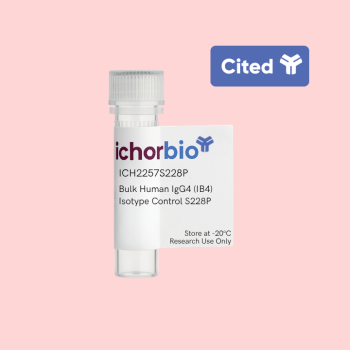 Bulk Human IgG4 (IB4) Isotype Control S228P$750.00 - $6,503.00
 -
 In Vivo Buffer pH7.2$112.50
