


Back to Top
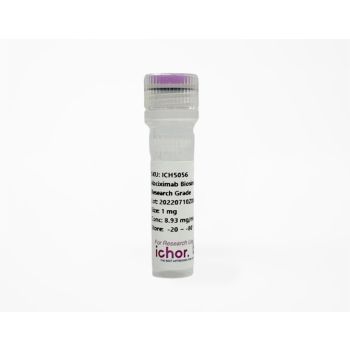
Guselkumab Biosimilar - Research Grade
$315.00 - $19,890.00
Frequently Bought Together
![Image of ichorbio's Clazakizumab Biosimilar - Research Grade [ICH5063]](https://ichor.bio/media/catalog/product/cache/7dc979ec4521a70fc3496447fd76f185/i/c/ich5063_clazakizumab_biosimilar_-_research_grade.webp)
![Image of ichorbio's Dupilumab Biosimilar - Research Grade [ICH5062]](https://ichor.bio/media/catalog/product/cache/7dc979ec4521a70fc3496447fd76f185/i/c/ich5062_dupilumab_biosimilar_-_research_grade.webp)

![Image of ichorbio's TSR-033 Biosimilar - Research Grade [ICH5067]](https://ichor.bio/media/catalog/product/cache/7dc979ec4521a70fc3496447fd76f185/i/c/ich5067_tsr-033_biosimilar_-_research_grade.webp)

Loading...
Guselkumab Biosimilar - Research Grade
Endotoxin
≤ 1.0 EU/mg as determined by the LAL method
Purity
>95% by SDS-PAGE
Species Reactivity
Human
Target
IL-23
Concentration
>1mg/ml
Isotype
Human IgG1-Lambda3
Antibodies Against The Same Target
Sequence
https://www.imgt.org/mAb-DB/
Buffer
ICH3002
Uniprot
Q9NPF7
Gene Id
51561
Rrid
RRID:AB_2921606
Shipping Conditions
Blue ice
Background
This product is an unconjugated, non-therapeutic recombinant analog of guselkumab, supplied strictly for research use only. It is built around the same molecular target as the originator antibody, human interleukin-23 (specifically the p19 subunit, IL-23A; UniProt Q9NPF7), and is formatted as a human IgG1-lambda immunoglobulin. It is not the clinical drug and is not intended for human or veterinary use. The preparation is offered at research grade with low endotoxin (typically <1 EU/mg, with ultra-low <0.5 EU/mg options), and can be produced in bulk milligram-to-gram quantities to support scaled and repeated experiments. Because it recapitulates the target-binding behaviour of the reference molecule, it is useful as a well-defined tool reagent for in-vitro and preclinical investigation of IL-23 biology: isotype-matched binding studies, cytokine neutralisation assays, positive/reference controls in comparator panels, ligand-blockade experiments, and as a benchmark antibody in assay development. Its consistency and availability in bulk make it suitable for standardising workflows across labs and over time.
Interleukin-23 (IL-23) is a heterodimeric, pro-inflammatory cytokine composed of a unique p19 subunit (IL-23A, encoded at UniProt Q9NPF7) covalently paired with the p40 subunit (IL12B) that it shares with IL-12. It is produced mainly by activated dendritic cells and macrophages. IL-23 signals through a receptor complex of IL-23R and IL-12RB1, driving JAK2/TYK2 and STAT3 activation. A central function is the survival, expansion, and terminal differentiation of T helper 17 (Th17) cells and other IL-17-producing populations, sustaining downstream release of IL-17, IL-22, and GM-CSF. This IL-23/Th17 axis is a key driver of chronic tissue inflammation and has been strongly implicated in psoriasis, psoriatic arthritis, and inflammatory bowel disease. Selective targeting of the p19 subunit blocks IL-23 while sparing IL-12, distinguishing it from p40-directed approaches.
Other Names
IL-23 subunit alpha, IL-23-A, Interleukin-23 subunit p19, IL-23p19, Interleukin-23 subunit alpha, SGRF
Specificity
Detects human IL23. This non-therapeutic antibody uses the same sequence as the therapeutic antibody Guselkumab.
Purification Method
This monoclonal antibody was purified using multi-step affinity chromatography methods such as Protein A or G depending on the species and isotype.
Formulation
Sterile, preservative-free, solution in PBS. BSA and Azide free.
Storage
This biosimilar is stable when stored at 2-8°C. For longer term storage (> 3 months) it is recommended to store this antibody at -20°C or -70°C.
Applications
Functional Assays
Application Notes
This biosimilar is for research use only (RUO): it is not for diagnostic or therapeutic procedures and cannot be purchased by patients.
Use
Products are for research use only. Not for use in diagnostic or therapeutic procedures.
Bio X Cell Code
SIM0025
Suggested H1
Guselkumab (anti-IL-23) Biosimilar
Faq (q&a)
Q: Is the Guselkumab biosimilar available in gram quantities?
A: Yes — it is supplied in scalable milligram to gram quantities for heavy-usage and high-throughput laboratories.
Q: Is this research-grade Guselkumab suitable for in vivo studies?
A: Yes, it is a low-endotoxin, in vivo-ready formulation intended for preclinical and in vivo research use only (RUO).
Q: What does the Guselkumab biosimilar target?
A: It is an unconjugated, non-therapeutic analog of Guselkumab that binds human IL-23.
Write Your Own Review
Is the Guselkumab biosimilar available in gram quantities?
Yes — it is supplied in scalable milligram to gram quantities for heavy-usage and high-throughput laboratories.
Is this research-grade Guselkumab suitable for in vivo studies?
Yes, it is a low-endotoxin, in vivo-ready formulation intended for preclinical and in vivo research use only (RUO).
What does the Guselkumab biosimilar target?
It is an unconjugated, non-therapeutic analog of Guselkumab that binds human IL-23.
Who Viewed This Also Viewed

Anti-Mouse CD44 (IM7) In Vivo Antibody - Low Endotoxin
$400.00 - $3,780.00

Anti-Mouse CD155 (4.24) In Vivo Antibody - Low Endotoxin
$400.00 - $2,945.00

Anti-Mouse CD45 (I3/2.3) In Vivo Antibody - Low Endotoxin
$400.00 - $2,945.00


Add recommended extras
-
 In Vivo Buffer pH7.2$112.50
 -
 Bulk Human IgG1 (IB1) Isotype Control$510.00 - $3,930.00
