


Back to Top
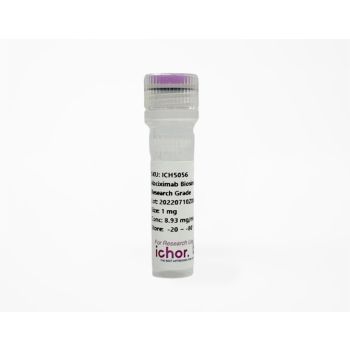
Margetuximab Biosimilar - Research Grade
$315.00 - $19,890.00
Frequently Bought Together


Loading...
Margetuximab Biosimilar - Research Grade
Endotoxin
≤ 1.0 EU/mg as determined by the LAL method
Purity
>95% by SDS-PAGE
Species Reactivity
Human
Target
HER2
Concentration
>1mg/ml
Isotype
Human IgG1
Antibodies Against The Same Target
Trastuzumab Biosimilar - Research Grade (ICH4013), Ado-Trastuzumab Emtansine Biosimilar - Research Grade (ICH4014), Pertuzumab Biosimilar - Research Grade (ICH4030), Anbenitamab Biosimilar - Research Grade (ICH5344), Calotatug Biosimilar - Research Grade (ICH5421), Coprelotamab Biosimilar - Research Grade (ICH5448), Disitamab Biosimilar - Research Grade (ICH5482), Gancotamab Biosimilar - Research Grade (ICH5562), Lunaxafusp Biosimilar - Research Grade (ICH5662), Timigutuzumab Biosimilar - Research Grade (ICH5925), Zanidatamab Biosimilar - Research Grade (ICH6002)
Sequence
https://www.imgt.org/mAb-DB/
Buffer
ICH3002
Uniprot
P04626
Shipping Conditions
Blue ice
Background
This is a research-grade, unconjugated non-therapeutic recombinant analog of margetuximab, a human IgG1 antibody directed against HER2 (ERBB2). It is supplied strictly for research use only and is not the clinical drug, nor is it intended for human or veterinary use. The analog reproduces the antigen-binding specificity of the originator against the HER2 ectodomain, making it a convenient reference tool for HER2-focused in-vitro work: as a positive binding control, a benchmarking reagent for HER2 assay development, a capture or detection partner in ELISA and flow cytometry, and a starting scaffold for antibody-drug-conjugate (ADC) and Fc-engineering studies. Because margetuximab was engineered for enhanced Fc effector function, the analog is also useful in comparative ADCC and Fc-receptor binding investigations. It is produced recombinantly for consistent lot-to-lot performance and is available at low endotoxin levels (research grade typically <1 EU/mg, ultra-low <0.5 EU/mg) and in bulk milligram-to-gram quantities suitable for preclinical model work and large in-vitro screens.
HER2 (human epidermal growth factor receptor 2), encoded by ERBB2 and mapping to UniProt P04626, is a 185 kDa single-pass transmembrane receptor tyrosine kinase in the EGFR/ErbB family. Unlike its relatives, HER2 has no known soluble ligand; it acts as the preferred heterodimerisation partner for EGFR, HER3, and HER4. Ligand-driven dimerisation juxtaposes the intracellular kinase domains, triggering trans-autophosphorylation and activation of the RAS-MAPK and PI3K-AKT pathways that drive proliferation and survival. ERBB2 amplification and HER2 protein overexpression occur in a subset of breast and gastric cancers and are associated with aggressive disease, making the receptor a central oncology target. The extracellular region comprises four subdomains (I-IV); therapeutic antibodies bind domain IV (as trastuzumab and margetuximab do) or the dimerisation arm in domain II, blocking signalling and engaging Fc-mediated effector mechanisms.
Other Names
Metastatic lymph node gene 19 protein, MLN 19, Proto-oncogene Neu, Proto-oncogene c-ErbB-2, Tyrosine kinase-type cell surface receptor HER2, p185erbB2, Receptor tyrosine-protein kinase erbB-2, ERBB2, NEU, NGL
Specificity
Detects human HER2. This non-therapeutic antibody uses the same sequence as the therapeutic antibody Margetuximab.
Purification Method
This monoclonal antibody was purified using multi-step affinity chromatography methods such as Protein A or G depending on the species and isotype.
Formulation
Sterile, preservative-free, solution in PBS. BSA and Azide free.
Storage
This biosimilar is stable when stored at 2-8°C. For longer term storage (> 3 months) it is recommended to store this antibody at -20°C or -70°C.
Applications
Functional Assays
Application Notes
This biosimilar is for research use only (RUO): it is not for diagnostic or therapeutic procedures and cannot be purchased by patients.
Use
Products are for research use only. Not for use in diagnostic or therapeutic procedures.
Faq (q&a)
Q: Is the Margetuximab biosimilar available in gram quantities?
A: Yes — it is supplied in scalable milligram to gram quantities for heavy-usage and high-throughput laboratories.
Q: Is this research-grade Margetuximab suitable for in vivo studies?
A: Yes, it is a low-endotoxin, in vivo-ready formulation intended for preclinical and in vivo research use only (RUO).
Q: What does the Margetuximab biosimilar target?
A: It is an unconjugated, non-therapeutic analog of Margetuximab that binds human HER2.
Write Your Own Review
Is the Margetuximab biosimilar available in gram quantities?
Yes — it is supplied in scalable milligram to gram quantities for heavy-usage and high-throughput laboratories.
Is this research-grade Margetuximab suitable for in vivo studies?
Yes, it is a low-endotoxin, in vivo-ready formulation intended for preclinical and in vivo research use only (RUO).
What does the Margetuximab biosimilar target?
It is an unconjugated, non-therapeutic analog of Margetuximab that binds human HER2.
Who Viewed This Also Viewed
Add recommended extras
-
 In Vivo Buffer pH7.2$112.50
 -
 Bulk Human IgG1 (IB1) Isotype Control$510.00 - $3,930.00
