


Back to Top
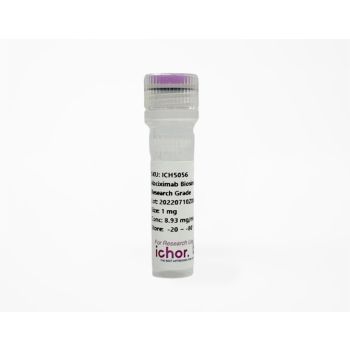
Nipocalimab Biosimilar - Research Grade
$315.00 - $19,890.00
Frequently Bought Together


![Image of ichorbio's Galcanezumab Biosimilar - Research Grade [ICH5046]](https://ichor.bio/media/catalog/product/cache/7dc979ec4521a70fc3496447fd76f185/i/c/ich5046_galcanezumab_biosimilar_-_research_grade.webp)
Loading...
Nipocalimab Biosimilar - Research Grade
Endotoxin
≤ 1.0 EU/mg as determined by the LAL method
Purity
>95% by SDS-PAGE
Species Reactivity
Human
Target
FcRn
Concentration
>1mg/ml
Isotype
Human IgG1-Lambda2
Antibodies Against The Same Target
Sequence
https://www.imgt.org/mAb-DB/
Buffer
ICH3002
Uniprot
P55899
Gene Id
2217
Rrid
RRID:AB_2921592
Shipping Conditions
Blue ice
Background
This product is an unconjugated, non-therapeutic recombinant analog of the anti-FcRn antibody nipocalimab, supplied strictly for research use only. It is a fully recombinant human IgG1-lambda protein built around the same molecular target, the neonatal Fc receptor (FcRn, encoded by FCGRT, UniProt P55899), and is intended as a laboratory reagent rather than as the clinical drug. It is not for human or veterinary use. The analog is useful for researchers studying FcRn biology, IgG homeostasis, and antibody half-life engineering: it serves as a defined positive control in FcRn-binding and IgG-recycling assays, as a benchmarking or reference molecule in comparability and bioanalytical method development, and as a tool for probing the FcRn-IgG interaction in vitro. Because it is offered at research grade with low endotoxin levels and in bulk milligram-to-gram quantities, it supports higher-throughput screening, structure-function studies, and preclinical model work where consistent, well-characterized material is needed. Ultra-low-endotoxin options support endotoxin-sensitive cell-based and functional assays.
FcRn (neonatal Fc receptor) is a non-classical MHC class I-like molecule composed of an FCGRT-encoded alpha chain (UniProt P55899) non-covalently associated with beta-2-microglobulin. It binds the Fc region of IgG and also albumin in a strictly pH-dependent manner: binding is tight in the acidic environment of the endosome (around pH 6) and released at near-neutral extracellular pH (around 7.4). Through this pH switch, FcRn rescues pinocytosed IgG and albumin from lysosomal degradation and recycles them back to the cell surface, extending their serum half-life. FcRn also mediates transcytosis of IgG across epithelial and placental barriers, contributing to maternal-to-fetal antibody transfer and mucosal immunity. Blocking the IgG-binding site on FcRn accelerates catabolism of circulating IgG, including pathogenic autoantibodies, which is the rationale behind FcRn-antagonist drug development.
Other Names
IgG Fc fragment receptor transporter alpha chain, Neonatal Fc receptor, IgG receptor FcRn large subunit p51, FCGRT
Specificity
Detects human FcRn. This non-therapeutic antibody uses the same sequence as the therapeutic antibody Nipocalimab.
Purification Method
This monoclonal antibody was purified using multi-step affinity chromatography methods such as Protein A or G depending on the species and isotype.
Formulation
Sterile, preservative-free, solution in PBS. BSA and Azide free.
Storage
This biosimilar is stable when stored at 2-8°C. For longer term storage (> 3 months) it is recommended to store this antibody at -20°C or -70°C.
Applications
Functional Assays
Application Notes
This biosimilar is for research use only (RUO): it is not for diagnostic or therapeutic procedures and cannot be purchased by patients.
Use
Products are for research use only. Not for use in diagnostic or therapeutic procedures.
Suggested H1
Nipocalimab (anti-FcRn) Biosimilar
Faq (q&a)
Q: Is the Nipocalimab biosimilar available in gram quantities?
A: Yes — it is supplied in scalable milligram to gram quantities for heavy-usage and high-throughput laboratories.
Q: Is this research-grade Nipocalimab suitable for in vivo studies?
A: Yes, it is a low-endotoxin, in vivo-ready formulation intended for preclinical and in vivo research use only (RUO).
Q: What does the Nipocalimab biosimilar target?
A: It is an unconjugated, non-therapeutic analog of Nipocalimab that binds human FcRn.
Write Your Own Review
Is the Nipocalimab biosimilar available in gram quantities?
Yes — it is supplied in scalable milligram to gram quantities for heavy-usage and high-throughput laboratories.
Is this research-grade Nipocalimab suitable for in vivo studies?
Yes, it is a low-endotoxin, in vivo-ready formulation intended for preclinical and in vivo research use only (RUO).
What does the Nipocalimab biosimilar target?
It is an unconjugated, non-therapeutic analog of Nipocalimab that binds human FcRn.
Who Viewed This Also Viewed


Add recommended extras
-
 In Vivo Buffer pH7.2$112.50
 -
 Bulk Human IgG1 (IB1) Isotype Control$510.00 - $3,930.00
