


Back to Top
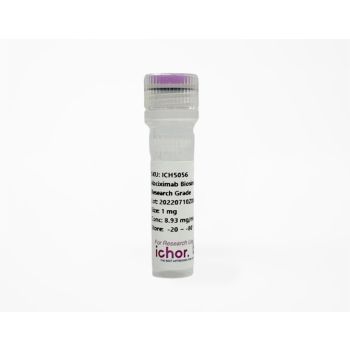
Isatuximab Biosimilar - Research Grade
$315.00 - $19,890.00
Frequently Bought Together


![Image of ichorbio's Selicrelumab Biosimilar - Research Grade [ICH5032]](https://ichor.bio/media/catalog/product/cache/7dc979ec4521a70fc3496447fd76f185/i/c/ich5032_selicrelumab_biosimilar_-_research_grade.webp)
Loading...
Isatuximab Biosimilar - Research Grade
Endotoxin
≤ 1.0 EU/mg as determined by the LAL method
Purity
>95% by SDS-PAGE
Species Reactivity
Human
Target
CD38
Concentration
>1mg/ml
Isotype
Human IgG1
Antibodies Against The Same Target
Bulk Anti-Human CD38 (OKT10) Antibody (ICH1157), Daratumumab Biosimilar - Research Grade (ICH4020), Erzotabart Biosimilar - Research Grade (ICH5533), Felzartamab Biosimilar - Research Grade (ICH5547), Lumrotatug Biosimilar - Research Grade (ICH5661), Mezagitamab Biosimilar - Research Grade (ICH5679)
Sequence
https://www.imgt.org/mAb-DB/
Buffer
ICH3002
Uniprot
P28907
Shipping Conditions
Blue ice
Background
This product is an unconjugated, non-therapeutic recombinant analog of isatuximab, a human IgG1 monoclonal antibody directed against the human cell-surface ectoenzyme CD38. It is supplied for research use only and is not the clinical drug; it is not intended for human or veterinary use. Built as a human IgG1 biosimilar around the CD38 target, it is useful as a well-defined reagent for in-vitro and preclinical research: binding and epitope characterization on CD38-expressing cells, ADCC/ADCP and complement-dependent-cytotoxicity assay development, CD38 enzymatic-activity modulation studies, and as a positive control or benchmarking standard when developing or validating other anti-CD38 binders. The recombinant human IgG1 format also makes it a convenient scaffold for antibody-drug-conjugate and Fc-engineering development work. It is offered at research-grade low endotoxin (<1 EU/mg, with ultra-low <0.5 EU/mg options) and in bulk milligram-to-gram quantities to support screening, assay standardization, and larger preclinical studies. No clone identity is implied.
CD38 (UniProt P28907) is a type II transmembrane glycoprotein and multifunctional ectoenzyme. It acts as an NAD+ glycohydrolase and ADP-ribosyl cyclase, generating cyclic ADP-ribose and NAADP, second messengers that regulate intracellular calcium signaling. Beyond its enzymatic role, CD38 functions as a receptor and adhesion molecule, interacting with CD31/PECAM-1 to modulate leukocyte activation, migration, and signaling. It is expressed at high levels on plasma cells and malignant plasma cells in multiple myeloma, and more broadly on activated lymphocytes, NK cells, monocytes, and various hematopoietic and non-hematopoietic tissues. This restricted-yet-strong expression on myeloma cells, together with CD38's contribution to NAD+ metabolism and immunosuppression in the tumor microenvironment, makes it an important target for antibody-mediated depletion and immunomodulation in hematologic research.
Other Names
ADP-ribosyl cyclase/cyclic ADP-ribose hydrolase 1, ADPRC 1, cADPr hydrolase 1
Specificity
Detects human CD38. This non-therapeutic antibody uses the same sequence as the therapeutic antibody Isatuximab.
Purification Method
This monoclonal antibody was purified using multi-step affinity chromatography methods such as Protein A or G depending on the species and isotype.
Formulation
Sterile, preservative-free, solution in PBS. BSA and Azide free.
Storage
This biosimilar is stable when stored at 2-8°C. For longer term storage (> 3 months) it is recommended to store this antibody at -20°C or -70°C.
Applications
Functional Assays
Application Notes
This biosimilar is for research use only (RUO): it is not for diagnostic or therapeutic procedures and cannot be purchased by patients.
Use
Products are for research use only. Not for use in diagnostic or therapeutic procedures.
Faq (q&a)
Q: Is the Isatuximab biosimilar available in gram quantities?
A: Yes — it is supplied in scalable milligram to gram quantities for heavy-usage and high-throughput laboratories.
Q: Is this research-grade Isatuximab suitable for in vivo studies?
A: Yes, it is a low-endotoxin, in vivo-ready formulation intended for preclinical and in vivo research use only (RUO).
Q: What does the Isatuximab biosimilar target?
A: It is an unconjugated, non-therapeutic analog of Isatuximab that binds human CD38.
Write Your Own Review
Is the Isatuximab biosimilar available in gram quantities?
Yes — it is supplied in scalable milligram to gram quantities for heavy-usage and high-throughput laboratories.
Is this research-grade Isatuximab suitable for in vivo studies?
Yes, it is a low-endotoxin, in vivo-ready formulation intended for preclinical and in vivo research use only (RUO).
What does the Isatuximab biosimilar target?
It is an unconjugated, non-therapeutic analog of Isatuximab that binds human CD38.
Who Viewed This Also Viewed
Add recommended extras
-
 In Vivo Buffer pH7.2$112.50
 -
 Bulk Human IgG1 (IB1) Isotype Control$510.00 - $3,930.00
