


Back to Top
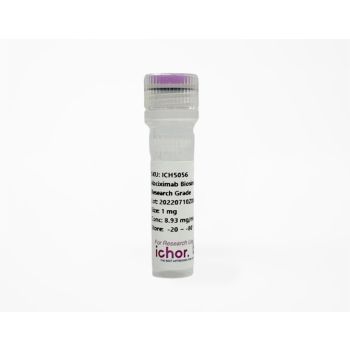
Cusatuzumab Biosimilar - Research Grade
$315.00 - $19,890.00
Frequently Bought Together


Loading...
Cusatuzumab Biosimilar - Research Grade
Endotoxin
≤ 1.0 EU/mg as determined by the LAL method
Purity
>95% by SDS-PAGE
Species Reactivity
Human
Target
CD70
Concentration
>1mg/ml
Isotype
Human IgG1-Lambda2
Antibodies Against The Same Target
Sequence
https://www.imgt.org/mAb-DB/
Buffer
ICH3002
Uniprot
P32970
Gene Id
970
Rrid
RRID:AB_2921581
Shipping Conditions
Blue ice
Background
CD70 is a costimulatory ligand whose aberrant expression on tumours and activated immune cells makes it an attractive node for immuno-oncology and immunology research. This product is an unconjugated, non-therapeutic research analog of cusatuzumab, a human IgG1 (lambda) monoclonal antibody directed against human CD70. It is recombinantly expressed and supplied strictly for research use only (RUO); it is not the clinical drug and is not intended for human or veterinary use. Because it is a biosimilar-format reagent, it references the originator antibody rather than any named hybridoma clone. Manufactured to in-vivo standards, it is offered at low endotoxin (research grade less than 1 EU/mg; ultra-low less than 0.5 EU/mg) and in scalable milligram-to-gram quantities, making it well suited to heavy-usage and high-throughput laboratories. Typical applications include CD70 binding and blockade characterisation, ligand-neutralisation assays, ADCC and effector-function studies, use as a defined positive reagent or benchmark, and antibody- and ADC-development workflows, where consistent, bulk-format material supports reproducible, longitudinal experimental designs.
CD70 (also known as CD27L or TNFSF7, UniProt P32970) is a type II transmembrane member of the tumour necrosis factor superfamily and the sole ligand for the costimulatory receptor CD27 (TNFRSF7). In healthy tissue its expression is tightly restricted and transient, appearing on activated T and B lymphocytes and mature dendritic cells. CD70-CD27 engagement delivers costimulatory signals that promote T-cell proliferation, effector and memory differentiation, and B-cell and NK-cell activation, while chronic signalling can drive T-cell exhaustion and regulatory-T-cell expansion. CD70 is frequently and aberrantly overexpressed in haematological malignancies and several solid tumours, where it can foster immune evasion and support tumour growth. This restricted-yet-tumour-associated pattern makes CD70 an important target for research into T-cell costimulation, tumour immunology, and antibody- and cell-based therapeutic strategies.
Other Names
CD27LG, TNFSF7
Specificity
Detects human CD70. This non-therapeutic antibody uses the same sequence as the therapeutic antibody Cusatuzumab.
Purification Method
This monoclonal antibody was purified using multi-step affinity chromatography methods such as Protein A or G depending on the species and isotype.
Formulation
Sterile, preservative-free, solution in PBS. BSA and Azide free.
Storage
This biosimilar is stable when stored at 2-8°C. For longer term storage (> 3 months) it is recommended to store this antibody at -20°C or -70°C.
Applications
Functional Assays
Application Notes
This biosimilar is for research use only (RUO): it is not for diagnostic or therapeutic procedures and cannot be purchased by patients.
Use
Products are for research use only. Not for use in diagnostic or therapeutic procedures.
Suggested H1
Cusatuzumab (anti-CD70) Biosimilar
Faq (q&a)
Q: Is the Cusatuzumab biosimilar available in gram quantities?
A: Yes — it is supplied in scalable milligram to gram quantities for heavy-usage and high-throughput laboratories.
Q: Is this research-grade Cusatuzumab suitable for in vivo studies?
A: Yes, it is a low-endotoxin, in vivo-ready formulation intended for preclinical and in vivo research use only (RUO).
Q: What does the Cusatuzumab biosimilar target?
A: It is an unconjugated, non-therapeutic analog of Cusatuzumab that binds human CD70.
Write Your Own Review
Is the Cusatuzumab biosimilar available in gram quantities?
Yes — it is supplied in scalable milligram to gram quantities for heavy-usage and high-throughput laboratories.
Is this research-grade Cusatuzumab suitable for in vivo studies?
Yes, it is a low-endotoxin, in vivo-ready formulation intended for preclinical and in vivo research use only (RUO).
What does the Cusatuzumab biosimilar target?
It is an unconjugated, non-therapeutic analog of Cusatuzumab that binds human CD70.
Who Viewed This Also Viewed


Add recommended extras
-
 In Vivo Buffer pH7.2$112.50
 -
 Bulk Human IgG1 (IB1) Isotype Control$510.00 - $3,930.00
