


Back to Top
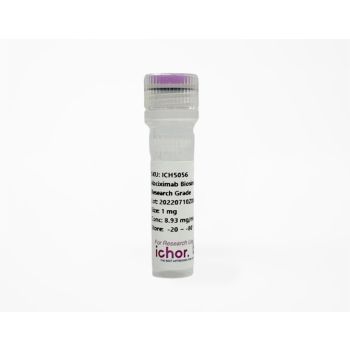
Avelumab Biosimilar - Research Grade
$315.00 - $19,890.00
Frequently Bought Together


Loading...
Avelumab Biosimilar - Research Grade
Endotoxin
≤ 1.0 EU/mg as determined by the LAL method
Purity
>95% by SDS-PAGE and HPLC
Species Reactivity
Human
Target
PD-L1
Concentration
>1mg/ml
Isotype
Human IgG1 lambda
Host
Humanized
Antibodies Against The Same Target
Anti-Mouse PD-L1 (10F.9G2) In Vivo Antibody - Low Endotoxin (ICH1086), Mouse Anti-Mouse PD-L1 (10F.9G2) Recombinant Antibody (ICH1183), Anti-Human PD-L1 (29E.2A3) In Vivo Antibody - Low Endotoxin (ICH1221), Atezolizumab Biosimilar - Research Grade (ICH4018), Durvalumab Biosimilar - Research Grade (ICH5005), Envafolimab Biosimilar - Research Grade (ICH5177), Benmelstobart Biosimilar - Research Grade (ICH5388), Betifisolimab Biosimilar - Research Grade (ICH5397), Cemavafusp Biosimilar - Research Grade (ICH5431), Cosibelimab Biosimilar - Research Grade (ICH5451), Danburstotug Biosimilar - Research Grade (ICH5464), Garivulimab Biosimilar - Research Grade (ICH5565), Lesabelimab Biosimilar - Research Grade (ICH5635), Manelimab Biosimilar - Research Grade (ICH5667), Opucolimab Biosimilar - Research Grade (ICH5740), Pacmilimab Biosimilar - Research Grade (ICH5752), Socazolimab Biosimilar - Research Grade (ICH5870), Sudubrilimab Biosimilar - Research Grade (ICH5885), Tagitanlimab Biosimilar - Research Grade (ICH5895)
Sequence
https://www.imgt.org/mAb-DB/
Buffer
ICH3001-100ml
ICH3002-100ml
ICH3003-100ml
Uniprot
Q9NZQ7
Gene Id
29126
Rrid
RRID:AB_2921535
Shipping Conditions
Blue ice
Background
This product is an unconjugated, non-therapeutic recombinant analog of avelumab, an anti-PD-L1 human IgG1 lambda antibody, supplied strictly for research use only. It is built around the same target, programmed death-ligand 1 (PD-L1, CD274; UniProt Q9NZQ7), and reproduces the binding specificity of the originator molecule without being the clinical drug; it is not intended for human or veterinary use. Because it carries a native, non-effector-silenced human IgG1 framework, this analog is well suited to studies of PD-L1 blockade alongside antibody-dependent cellular cytotoxicity (ADCC), a feature distinguishing avelumab from several other PD-1/PD-L1 antibodies. Typical research applications include positive and reference controls in binding and neutralization assays, benchmarking of biosimilar or novel anti-PD-L1 candidates, ADCC and ADC-development workflows, and preclinical in-vitro immuno-oncology models. It is offered at research grade with low endotoxin (<1 EU/mg; ultra-low <0.5 EU/mg options), in-vivo-standard formulations, and in bulk milligram-to-gram quantities to support scale-up and assay standardization.
PD-L1 (programmed death-ligand 1, also called CD274 or B7-H1; UniProt Q9NZQ7) is a type I transmembrane glycoprotein of the B7 immunoglobulin superfamily. It is expressed on antigen-presenting cells, many other tissues under inflammatory conditions, and is frequently upregulated on tumor cells, often driven by interferon-gamma. PD-L1 engages the inhibitory receptor PD-1 on activated T cells, delivering a co-inhibitory signal that dampens T-cell receptor signaling, reduces proliferation and cytokine production, and promotes T-cell exhaustion. It also binds CD80 (B7-1) in cis and trans, adding a further layer of immune regulation. This PD-1/PD-L1 axis maintains peripheral tolerance but is co-opted by tumors to evade immune surveillance. Blocking PD-L1 restores effector T-cell activity, which underpins its central role as an immune-checkpoint target.
Other Names
Programmed cell death 1 ligand 1, Cd274, PDCD1 ligand 1, Programmed death ligand 1, B7 homolog 1, B7-H1, B7h1, Pdcd1l1, Pdcd1lg1, Pdl1, PDL-1
Specificity
Detects human PDL-1. This non-therapeutic antibody uses the same sequence as the therapeutic antibody Avelumab.
Purification Method
This monoclonal antibody was purified using multi-step affinity chromatography methods such as Protein A or G depending on the species and isotype.
Formulation
Phosphate buffered saline (PBS) pH 7.2,with no carrier protein, potassium or preservatives added. BSA and Azide free.
Storage
Stable for at least one week when stored sterile at 2-8°C. For long term storage aseptically aliquot in working volumes without diluting and store at –80°C. Avoid Repeated Freeze Thaw Cycles.
Use
Products are for research use only. Not for use in diagnostic or therapeutic procedures.
Bio X Cell Code
SIM0021
Suggested H1
Avelumab (anti-PD-L1) Biosimilar
Faq (q&a)
Q: Is the Avelumab biosimilar available in gram quantities?
A: Yes - it is supplied in scalable milligram to gram quantities for heavy-usage and high-throughput laboratories.
Q: Is this Avelumab biosimilar suitable for in vivo studies?
A: Yes, it is a low-endotoxin, in vivo-ready formulation intended for preclinical and in vivo research use only (RUO).
Q: What does the Avelumab biosimilar target?
A: It is an unconjugated, non-therapeutic biosimilar analog of Avelumab that binds human PD-L1; for research use only (RUO).
Write Your Own Review
Is the Avelumab biosimilar available in gram quantities?
Yes - it is supplied in scalable milligram to gram quantities for heavy-usage and high-throughput laboratories.
Is this Avelumab biosimilar suitable for in vivo studies?
Yes, it is a low-endotoxin, in vivo-ready formulation intended for preclinical and in vivo research use only (RUO).
What does the Avelumab biosimilar target?
It is an unconjugated, non-therapeutic biosimilar analog of Avelumab that binds human PD-L1; for research use only (RUO).
Who Viewed This Also Viewed


Anti-Mouse CD25 (PC61) In Vivo Antibody - Low Endotoxin
$400.00 - $3,780.00


Anti-CD4 (GK1.5) In Vivo Antibody - Low Endotoxin
$150.00 - $23,460.00
Add recommended extras
-
 In Vivo Buffer pH7.2$112.50
 -
 Bulk Human IgG1 (IB1) Isotype Control$510.00 - $3,930.00
